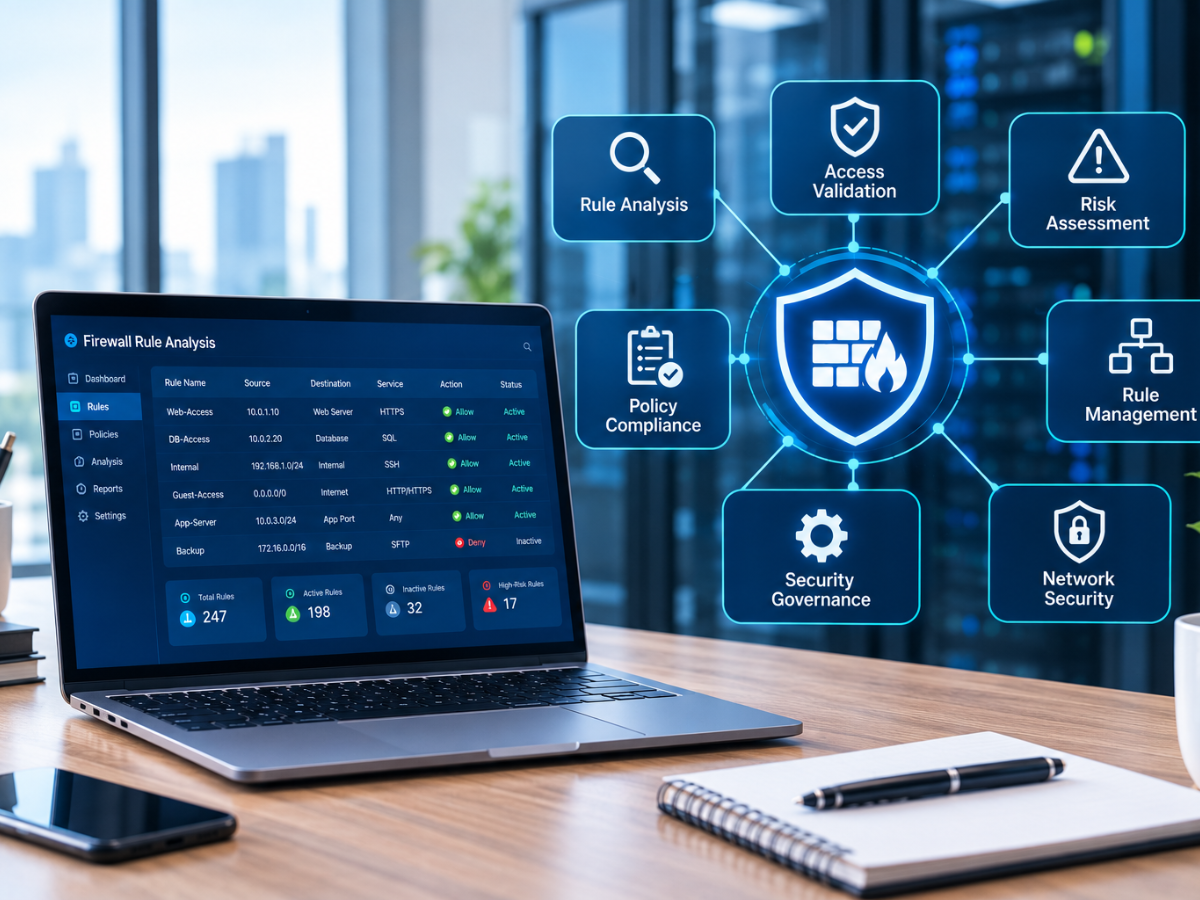



Cybersecurity risks can start with something that seems small, such as an outdated firewall rule, unnecessary network access, or a forgotten user permission. If these issues are not identified early, they can create larger security and operational problems. As businesses expand their networks, adopt cloud applications, work with third party services, and connect more devices, maintaining clear visibility into security risks becomes increasingly important. Identifying potential weaknesses early allows businesses to understand their exposure, prioritize risks, and take action before smaller issues develop into larger problems.
In this blog, you will learn how businesses can identify cybersecurity risks, determine which risks require immediate attention, and use regular network security assessments to build stronger security practices. You will also discover how firewall risk assessment and modern firewall management solutions can help businesses improve visibility, manage security policies, and maintain greater control over their network environment.
Why Cybersecurity Risks Need Early Attention
For many shop owners and growing businesses, cybersecurity can feel like something that belongs to large corporations with dedicated security teams. In reality, even a small business can depend on payment systems, customer information, cloud applications, Wi Fi networks, computers, point of sale systems, and connected devices every day.
Each of these systems can introduce security considerations. A configuration that was appropriate several years ago may no longer make sense today. A temporary access rule created for a third party may remain active after the project has finished. An employee account may continue to have permissions that are no longer necessary.
These issues do not always create an immediate security incident. However, they can increase the attack surface and make it more difficult for security teams to understand where potential weaknesses exist.
This is why a cybersecurity risk assessment should not only happen after something goes wrong. Businesses need a proactive approach that helps them identify weaknesses, understand their significance, and address them before they become more serious.
Start With a Clear View of Your Security Environment
You cannot prioritize a risk that you cannot see. The first step toward better cybersecurity risk management is understanding what exists within your environment. Businesses need visibility into their systems, network connections, access policies, firewall configurations, applications, and other components that influence security.
This becomes more challenging as organizations grow. A business may operate several firewalls, cloud environments, remote access systems, branch offices, and security policies. Each environment can contain its own configurations and access requirements.
Network security assessments can help businesses review their security environment and identify areas that require attention. A useful assessment should consider more than whether a firewall is switched on or whether security software has been installed. It should examine how policies are configured and how they are being used.
Areas worth reviewing can include:
- Firewall access rules
- Unused or inactive rules
- Overly permissive policies
- Conflicting rules
- Redundant configurations
- Expired access
- Excessive permissions
- Network segmentation
- Configuration inconsistencies
- Changes to security policies
- Access involving third party services
The objective is not simply to create a long list of findings. The goal is to create a clearer picture of the organization’s actual security environment. When businesses understand what is happening across their network, they can make more informed decisions about where security resources should be directed.
How to Identify and Prioritize Security Risks
Not every cybersecurity issue requires the same response. A business may discover dozens or even hundreds of findings during a security review. Treating every finding as an emergency can overwhelm security teams and make it difficult to focus on the issues that require meaningful attention. Instead, businesses can prioritize risks according to several practical factors.
Start by asking what could happen if a particular weakness were exploited. Could the issue affect payment systems, customer information, business applications, sensitive data, or daily operations?
A security issue affecting a critical business application may deserve more immediate attention than an issue involving a low impact internal system. Understanding business impact allows security teams to connect technical findings with real operational consequences.
The amount of access provided by a rule or configuration is another important consideration. A rule that permits broad network access may require closer examination than a rule that provides tightly controlled access to a specific application or system. Businesses should understand who or what can access a resource, where the access originates, and what systems can be reached through that access.
Risk prioritization should also consider how an affected system or policy is actually being used. For example, a firewall rule that has existed for years but is never used may represent a different type of concern from a highly active rule that provides broad access to important systems. Actual usage information can provide useful context when deciding what should be reviewed or changed.
Old rules and configurations can remain in environments long after their original purpose disappears. Businesses regularly change applications, employees, vendors, locations, and infrastructure. Security policies need to evolve with those changes. Regular reviews can help identify rules that are unused, expired, redundant, or no longer aligned with current business requirements. A firewall risk assessment can bring these considerations together and help security teams focus their time on meaningful risks rather than manually reviewing every configuration without context.
Look Beyond the Obvious Threats
Some cybersecurity risks are easy to notice. Others are hidden within everyday network management. Consider a retail business that provides temporary access to a third party during a software installation. The installation is completed successfully, and employees move on to other priorities. However, the firewall rule created for the project remains active.
Months later, nobody may remember why the access exists. The rule may not generate an obvious warning, yet it creates unnecessary exposure. This is one reason security teams need to look beyond active threats and consider policy hygiene as part of ongoing security management.
Other examples can include:
- Rules that were created for temporary projects
- Access permissions that are no longer required
- Duplicate firewall rules
- Rules that are never used
- Policies that conflict with other rules
- Expired access that remains configured
- Broad rules that could be made more specific
- Configurations that no longer reflect business requirements
These conditions may develop gradually as businesses make changes to their infrastructure. This is where continuous analysis can become valuable. Opinnate provides visibility into risky, conflicting, shadowed, expired, unused, and permissive firewall rules, helping teams understand policy behaviour and real usage.
Why Manual Security Reviews Can Become Difficult
Manual reviews can be useful, especially for smaller environments. However, they can become increasingly difficult as the number of systems, firewall rules, applications, and business locations grows. Imagine a business managing thousands of firewall rules across multiple environments. Security teams may need to determine which rules are active, which ones are unused, which were recently changed, and whether existing policies still support current business requirements.
Performing this process manually can consume significant time. There is also a risk of inconsistency. Different team members may review policies differently, and important information can be difficult to maintain when documentation is spread across multiple systems.
Automation and centralized visibility can help address some of these challenges. The objective is not to remove human decision making from security operations. Instead, technology can help security teams identify areas that require attention so they can spend more time evaluating risks and making informed changes.
Turning Risk Assessment Into Everyday Security
A cybersecurity risk assessment should lead to action, not simply produce a report that gets filed away. Once risks have been identified and prioritized, businesses should establish a process for addressing them. This can include:
- Reviewing high priority findings
- Removing unnecessary access
- Updating outdated rules
- Documenting policy changes
- Establishing approval processes
- Monitoring rule usage
- Reviewing expired access
- Tracking changes over time
- Reassessing policies after major infrastructure changes
- Maintaining consistent security practices
This creates a repeatable security process rather than relying on occasional manual checks. Modern firewall management solutions can support this process by providing centralized visibility, policy analysis, reporting, optimization, and controlled automation. For businesses operating across on premises and cloud environments, centralized policy visibility can also help reduce inconsistencies between different environments.
How Continuous Policy Analysis Supports Better Risk Management
Cybersecurity environments are constantly changing. A new application can be introduced. A cloud service can be added. An employee can change roles. A vendor relationship can end. A business can open a new location. Network infrastructure can be redesigned.
Every change can potentially affect security policies. This means that a security assessment performed once may not provide a complete picture several months later. Continuous policy analysis helps businesses keep security considerations connected to these changes. Instead of treating risk assessment as a single event, organizations can make it part of their broader security management process. This approach can help teams identify changes that deserve review and reduce the likelihood of outdated policies remaining unnoticed.
When Your Business Needs a Closer Security Review
Certain situations should encourage businesses to take a closer look at their security risks. For example, consider reviewing your environment when you:
- Add a new firewall or cloud environment
- Make significant network changes
- Introduce new applications or third party services
- Discover outdated or unnecessary firewall rules
- Prepare for an audit
- Experience repeated configuration issues
- Expand the business and add new locations or systems
- Find it difficult to understand which firewall rules are still being used
- Change access requirements for employees or vendors
- Replace or upgrade network infrastructure
These events can change the security environment and create a need for additional review. Regular network security assessments can help businesses establish a clearer baseline and identify changes that deserve attention.
Building a More Proactive Security Culture
Technology is only one part of effective cybersecurity. Businesses also need processes that encourage employees and security teams to think about risk during everyday operations. For example, when a new application is introduced, security should be considered during implementation rather than months later. When a third party receives network access, there should be a process for reviewing that access when the business relationship changes.
Similarly, when a firewall rule is created, teams should understand its purpose and consider when it should be reviewed. This type of approach creates better security habits across the organization. A proactive security culture does not require every employee to become a cybersecurity specialist. Instead, it means establishing practical processes that make security part of normal business decisions.
Make Security Risks Easier to Manage
Cybersecurity does not always fail because a business ignored security completely. Sometimes, problems develop because small issues remain unnoticed for too long. An outdated firewall rule, unnecessary permission, forgotten access path, or unused policy may appear insignificant on its own. However, when these issues accumulate, they can make an organization’s security environment harder to manage and understand.
A structured cybersecurity risk assessment helps businesses identify those issues, understand their potential impact, and prioritize the actions that matter most. Combined with firewall risk assessment and effective firewall management solutions, this approach can give security teams better visibility and greater control over their network security environment.
The goal is not simply to identify more risks. It is to understand which risks matter, why they matter, and what action should be taken. If you want to understand your firewall policies, identify potential risks, and strengthen your network security practices, explore how Opinnate can help you move from manual reviews toward continuous policy analysis and controlled security management.
Frequently Asked Questions
1. What is a cybersecurity risk assessment?
A cybersecurity risk assessment is a structured review of an organization’s systems, policies, configurations, access controls, and potential vulnerabilities. It helps businesses understand their security exposure and determine which risks require attention first.
2. Why are network security assessments important?
Network security assessments help businesses identify weaknesses, policy issues, configuration problems, unnecessary access, and other conditions that could contribute to security risks. Regular assessments can also help organizations maintain better visibility as their environments change.
3. What is a firewall risk assessment?
A firewall risk assessment examines firewall rules and configurations to identify conditions such as excessive access, conflicts, unused rules, outdated policies, and other potential security concerns. It can help teams understand where firewall policies may require review or improvement.
4. How often should businesses conduct cybersecurity risk assessments?
The appropriate frequency depends on the size and complexity of the environment. Businesses should consider regular reviews and additional assessments after major infrastructure, application, firewall, network, or policy changes.
5. How can firewall management solutions help businesses?
Firewall management solutions can provide centralized visibility, policy analysis, reporting, optimization, and controlled automation. These capabilities can reduce manual work while helping teams identify and address policy risks more consistently.
6. What are some common cybersecurity risks businesses should look for?
Common areas of concern can include outdated firewall rules, excessive access, unused policies, conflicting rules, unnecessary permissions, expired third party access, configuration inconsistencies, and security policies that no longer reflect current business requirements.
7. Why are outdated firewall rules a security concern?
Outdated firewall rules can continue allowing access that is no longer required. If the original business purpose of a rule has disappeared, reviewing or removing that rule can help reduce unnecessary exposure and improve overall policy hygiene.
8. Can small businesses benefit from network security assessments?
Yes. Small businesses also rely on payment systems, cloud applications, customer information, Wi Fi networks, computers, and connected devices. Network security assessments can help identify potential weaknesses before they become larger operational or security concerns.
9. What should businesses do after identifying a cybersecurity risk?
Businesses should assess the potential impact and exposure of the finding, determine whether the risk is still relevant, and decide what action is appropriate. Depending on the situation, this could involve updating a policy, removing unnecessary access, improving documentation, or conducting further investigation.
10. How can businesses make cybersecurity risk management more proactive?
Businesses can make risk management more proactive by conducting regular assessments, monitoring policy changes, reviewing firewall rules, removing unnecessary access, documenting approvals, and using technology that provides ongoing visibility into security policies and their usage.