


Faster Implementation. Deeper Governance.
Opinnate gives teams a faster path to policy value with lower implementation friction, stronger adoption, and continuous governance.
Faster implementation path
Lower operational overhead
Continuous optimization and monitoring
Better fit for teams prioritizing speed and governed action
A More Practical Path to Value
How Opinnate and Tufin differ across implementation, operating model, and policy operations
Comparison
Implementation Path
Platform Approach
Policy Operations
Best-Fit Environment
- Faster path to production rollout
- Lower setup friction for teams
- Higher user adoption after onboarding
- Lightweight governance layer
- Works with existing infrastructure
- Designed for faster operationalization
- Continuous policy visibility and usage insight
- Governed automation workflows
- Faster move from analysis to action
- Teams prioritizing speed, control, and continuous policy operations
- Modern or hybrid environments
- Organizations reducing operational drag
- Longer rollout path in complex environments
- Greater setup and training overhead
- Slower path from deployment to broad usage
- Broader platform footprint
- More infrastructure-dependent rollout
- Heavier operating model over time
- More traditional policy operations model
- Greater reliance on staged workflows
- Slower transition from visibility to action
- Environments with heavier legacy constraints
- Teams accepting longer rollout cycles
- Organizations prioritizing broader legacy support over rollout speed
Why That Difference Matters
Many governance platforms promise control, but the trade-off is often rollout friction, training overhead, and slower time to value. With Opinnate, AI-powered firewall analysis, optimization, and automation deliver faster, safer outcomes.
Which Approach Fits Your Environment?
Opinnate
Best for teams prioritizing speed, governed action, and continuous policy operations
- You want policy governance that becomes operational in weeks, not quarters
- Analysis, optimization, and automation need to work as one motion
- Your environment values lighter integration and lower operational friction
- Continuous visibility and governed change matter more than periodic review cycles
Ideal for:
Tufin
Best suited for environments where broader legacy accommodation outweighs rollout speed
- You operate in a heavier legacy environment with stricter platform dependencies
- Longer onboarding and broader training overhead are acceptable trade-offs
- Policy operations can follow a more staged path to value
- Broader infrastructure accommodation matters more than lighter day-to-day operations
Ideal for:
Why Organizations Start Looking for a Tufin Alternative?
Extended Deployment Effort
Getting the platform fully deployed and operational can require significant planning and resources before teams see the intended value.
Multi Step Policy Processes
Policy requests and changes may pass through several stages, creating opportunities for delays between identifying a need and completing the action.
Uneven Platform Adoption
When workflows feel difficult to navigate or require specialist knowledge, broader adoption across security and network teams can become harder to achieve.
Operational Maintenance Burden
As the environment expands, administration, integrations, workflows, and platform upkeep can add another layer of work for security teams.
Complexity During Scale Up
Growing firewall estates can increase licensing, administration, training, and governance demands, making operational efficiency increasingly important.
Evaluating Tufin Alternatives? Key Factors to Consider
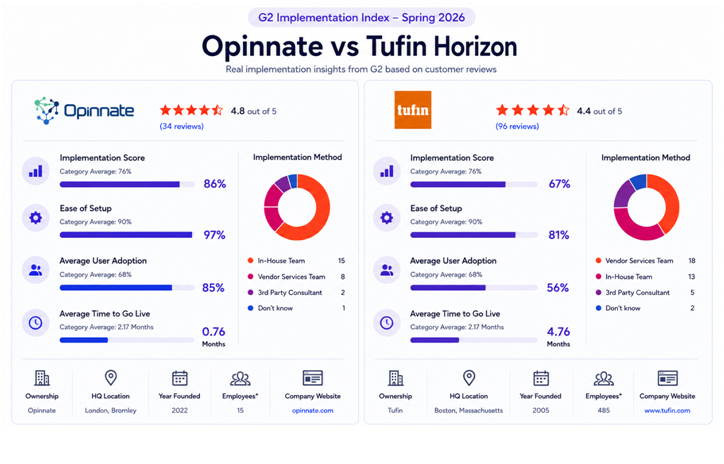
Switching from Tufin? What to Consider Before You Migrate
Determine how existing rule sets, policy data, and established workflows will be handled during the transition
Plan the changeover carefully to avoid service interruptions, enforcement gaps, or unexpected policy behaviour
Assess whether the existing and new approaches can be evaluated alongside each other before the final transition
Identify the training and process changes needed for administrators and security teams to become productive
Establish a clear fallback approach if validation reveals issues or the migration needs to be paused
Why Organizations Choose Opinnate over Tufin
Shorter Deployment Path
AI Powered Policy Analysis and Optimization
Automated Governance With Practical Control
Fits Into Existing Security Infrastructure
Faster Adoption With Less Operational Friction
Frequently Asked Questions
Opinnate is positioned around faster implementation and reduced deployment friction, while Tufin typically involves a more structured and enterprise-heavy implementation process.
Opinnate is designed to provide a faster path to operational value through streamlined governance, analysis, optimization, and automation workflows. Tufin’s time to value is generally influenced by the scale and complexity of enterprise deployment.
Tufin is associated with deep policy governance, path analysis, and compliance monitoring capabilities. Opinnate focuses on combining analysis with optimization and action in a continuous operational flow.
Tufin provides established automation capabilities for policy and compliance workflows. Opinnate emphasizes automation integrated directly with analysis and optimization for continuous operational efficiency.
Both platforms support hybrid environments. Opinnate emphasizes unified operational visibility and efficiency, while Tufin focuses on multi-platform policy control and structured management across environments.
The page uses licensed G2 Implementation Index proof as third-party validation to support implementation experience and time-to-value positioning.
Opinnate is aligned with teams seeking faster operational value, streamlined governance, and reduced implementation complexity. Tufin is suited for enterprises requiring deep policy control, compliance depth, and large-scale environment management.