


Faster Path to Policy Governance. Beyond Monitoring.

Opinnate helps teams move from firewall visibility to governed action with lower manual effort, stronger optimization, and faster operational value.
👥
85%
vs
59%
User Adoption
🏲
🕒
0.76
vs
2.44
Months to Go Live
🏲
Faster path to operational value
Lower manual effort across workflows
Continuous policy optimization
Clear path from insight to remediation

A More Complete Approach to Policy Operations

How Opinnate and ManageEngine Firewall Analyzer differ across implementation, operating model, and policy operations

Comparison

Implementation Path

Time to value and onboarding

Platform Approach

Integration and operating model

Policy Operations

Analysis, optimization, and governed action

Visibility and Reporting

Monitoring, alerts, and audit readiness
Opinnate
Manage Engine

Why That Difference Matters

Visibility alone is no longer enough. The real advantage comes from how effectively teams can move from insight to governed action without relying on manual processes.
Tools like ManageEngine Firewall Analyzer provide strong monitoring, reporting, and alerting capabilities, helping teams understand firewall activity and support compliance efforts. However, these workflows often stop at analysis, requiring additional manual effort to translate insight into action.

Opinnate is designed to extend beyond monitoring. It connects visibility with optimization and automation, enabling teams to continuously improve policy posture and execute governed changes without unnecessary operational overhead.

Which Approach Fits Your Environment?

A practical guide based on rollout speed, operating model, and policy governance needs

Opinnate

Best for teams prioritizing governed action and continuous policy operations

Ideal for:

Modern enterprises, hybrid environments, and teams focused on operational efficiency with strong policy control

ManageEngine Firewall Analyzer

Best suited for teams focused on visibility, reporting, and monitoring

Ideal for:

Organizations prioritizing firewall monitoring, reporting, and compliance visibility over full governance automation

Why Organisations Start Looking for a ManageEngine Alternative?

Most organisations exploring a ManageEngine alternative already have established firewall policy processes. The question is whether those processes still provide the efficiency, visibility, and governance the security team needs today. As environments become more demanding, organisations may begin looking for an alternative because of challenges such as:

Lengthy Implementation Processes

Getting a firewall policy management platform operational can require more time and coordination, delaying its full operational value.

Manual Policy Workflows

Teams may have access to policy information, yet still depend on manual coordination to review findings, make decisions, and move policy changes through the appropriate workflow.

Limited User Adoption

If workflows feel difficult or overly dependent on specialist users, adoption can remain concentrated within a small part of the security team.

Ongoing Rule Base Maintenance

Firewall rule cleanup can become an ongoing operational burden when teams have to repeatedly identify outdated, unnecessary, or inefficient rules through manual processes.

Growing Operational Demands

As firewall environments and security requirements expand, the time and coordination needed to maintain effective policy operations can increase, placing additional pressure on security teams.

These issues do not automatically mean an existing deployment is unsuccessful. They may simply indicate that an organisation’s requirements have evolved and that its current approach is no longer the best fit for its operational model, governance expectations, or long-term security strategy.
Evaluating a ManageEngine replacement can give security teams an opportunity to reassess their existing firewall policy processes, identify areas for improvement, and select an approach that better supports current security, compliance, and operational objectives.

Evaluating ManageEngine Alternatives? Key things to Consider
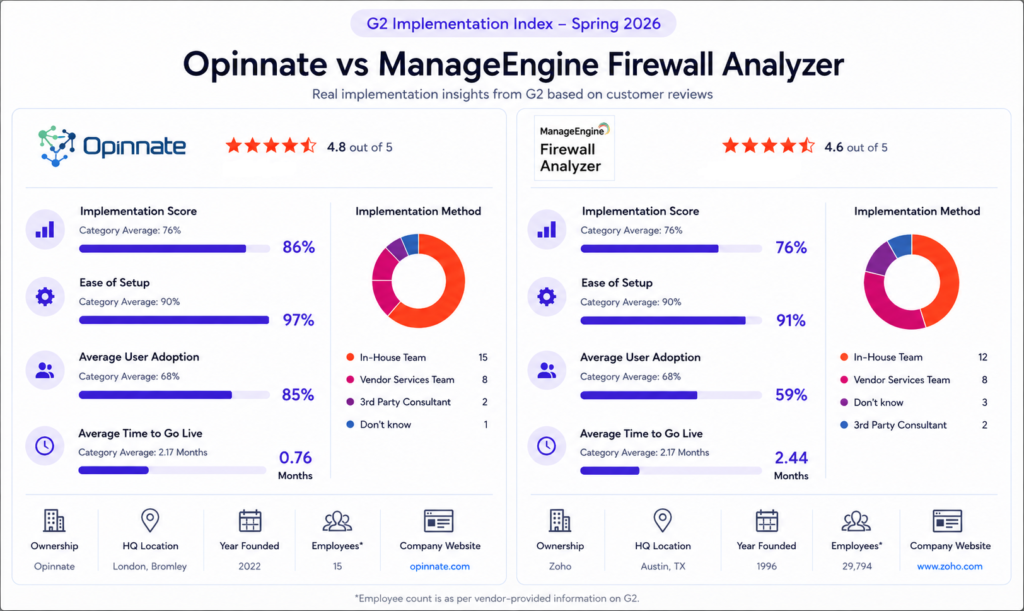
Many organisations start searching for a ManageEngine alternative when their firewall policy operations become harder to manage as security requirements evolve. The decision is rarely based on features alone. Teams also need to consider how quickly a platform can be introduced, how easily users can adopt it, and whether it can support stronger policy governance without adding unnecessary complexity.
The G2 Implementation Index referenced on this page highlights meaningful differences in implementation experience. Opinnate records 86% for implementation versus 76% for ManageEngine, with 85% user adoption versus 59% and a reported 0.76 months from deployment to go live versus 2.44 months. These measures help show how the platforms can differ beyond their feature sets.
G2 Implementation Index comparison chart between Opinnate and ManageEngine Firewall Analyzer showing review ratings and setup metrics
Opinnate is built for organisations that want to make firewall policy analysis, optimisation, and controlled automation more efficient while retaining their existing security infrastructure. By bringing visibility and governance into a streamlined workflow, Opinnate helps security teams reduce manual effort and manage policy operations with greater consistency.

Switching from ManageEngine? What to Consider Before You Migrate

Moving away from an established firewall policy management platform requires careful planning. Existing rule bases, approval processes, operational procedures, and team experience all need to be considered before making a transition. The main areas organisations typically evaluate include:
Rule and policy carryover

Whether existing firewall rules and policies can be transitioned effectively without creating unnecessary rework for security teams.

Disruption during cutover

Whether the transition can be planned without creating avoidable interruptions or gaps in firewall policy enforcement.

Parallel operation

Whether teams can assess the new platform alongside their current processes before completing the transition.

Team ramp up

How quickly security teams can become comfortable with the new workflows and use the platform effectively

Rollback

Whether there is a practical path to pause, adjust, or reverse the migration if requirements change during the process.

A platform transition does not have to be viewed simply as replacing one solution with another. It can also provide an opportunity to review existing firewall policy processes, remove unnecessary manual steps, improve visibility, and establish clearer governance. The appropriate migration strategy will depend on the organisation’s firewall environment, internal workflows, compliance needs, and operational priorities.

Why Organisations Choose Opinnate over ManageEngine

Purpose-built for teams that want faster outcomes, continuous governance and lower operational complexity.

Faster Implementation with Quick Time to Value

AI-Powered Policy Analysis & Automation

Continuous Policy Governance

Seamless Integration with Existing Infrastructure

Lower Operational Overhead with Higher User Adoption

Teams considering a move from ManageEngine are often looking for more than another set of firewall management features. They want a clearer connection between identifying policy issues, deciding what should change, and putting those changes through a controlled governance process.
If your organisation wants to simplify firewall policy operations, reduce manual effort, and give security teams a more efficient way to manage policy governance, Opinnate offers a practical alternative to ManageEngine with a focus on faster adoption and continuous policy oversight.
Need help deciding? Our team can walk through your specific requirements and infrastructure to recommend the best path forward.

Frequently Asked Questions

Common questions about Opinnate’s approach to governance
Opinnate provides a broader policy governance platform, while ManageEngine Firewall Analyzer focuses primarily on monitoring, reporting, and visibility.
Opinnate is designed for faster time to value with a more direct path to action, while ManageEngine typically requires additional steps beyond analysis.
Opinnate connects analysis, optimization, and automation into a continuous workflow, whereas ManageEngine centers on reporting and alert-driven monitoring.
It supports visibility and compliance reporting, but governance and remediation workflows often require additional manual processes.
Both can support hybrid setups, but Opinnate is optimized for continuous governance across modern, distributed infrastructures.
Opinnate suits teams seeking full policy lifecycle management, while ManageEngine fits teams focused on monitoring and reporting needs.
Organisations may explore ManageEngine alternatives when they want to simplify firewall policy operations, reduce manual effort, improve policy visibility, or create a more efficient path from analysis to governed action. The right option depends on the organisation’s infrastructure, security priorities, workflows, and governance requirements.
Yes. Opinnate is designed for organisations looking for a focused firewall policy management approach that supports policy analysis, optimisation, automation, and continuous governance. It can be particularly relevant for teams seeking a streamlined operational model and improved efficiency.
For organisations managing security across hybrid environments, reducing operational complexity and maintaining consistent firewall policy governance are important considerations. Opinnate is designed to help security teams maintain policy visibility and governance while working with their existing security infrastructure.
Migration requirements vary depending on the existing firewall environment, policy structure, workflows, and operational processes. A phased approach that includes planning, policy validation, testing, and controlled implementation can help organisations manage the transition while reducing unnecessary disruption.
Opinnate brings policy visibility, analysis, optimisation, automation, and governance together within a continuous workflow. This approach helps security teams reduce fragmented manual processes while creating a more consistent way to manage firewall policies and ongoing policy operations.

Ready to move beyond monitoring?

See how Opinnate delivers continuous policy governance with less manual effort and faster operational impact.