


Faster Path to Governed Action. Less Operational Complexity.
- View Implementation Insights
Faster path to operational value
Lower workflow complexity
Continuous policy optimization
Clear path from insight to action
A More Practical Approach to Policy Governance
Comparison
Implementation Path
Platform Approach
Policy Operations
Compliance and Governance
- Faster rollout with streamlined onboarding
- Lower setup friction across environments
- Quicker path to operational usage
- Lightweight governance across existing systems
- Lower dependency on deep integrations
- Simpler model with continuous operations
- Unified flow from analysis to execution
- Continuous optimization with automation
- Faster move from insight to action
- Continuous governance across policy lifecycle
- Built-in audit readiness and visibility
- Governed automation with clear control
- Structured rollout across complex environments
- Higher setup and integration requirements
- Longer path to full operational adoption
- Broad platform across firewall and cloud layers
- Strong reliance on multi-vendor integrations
- More layered operating model over time
- Strong risk analysis and policy validation
- Automated workflows with structured steps
- More staged path from analysis to change
- Strong compliance tracking and reporting
- Continuous monitoring for policy violations
- Automated recertification and audit workflows
Why That Difference Matters
Platforms like FireMon provide strong capabilities in visibility, compliance enforcement, and large-scale network policy management across complex environments. These strengths make them well-suited for enterprises managing extensive, multi-vendor infrastructures—but they often come with more structured workflows and operational overhead.
Opinnate is designed to simplify that experience. It connects analysis, optimization, and automation into a more continuous flow, enabling teams to act on insights faster while maintaining strong governance—without adding unnecessary complexity.
Which Approach Fits Your Environment?
A practical guide based on rollout speed, operating model, and policy governance needs
Opinnate
Best for teams prioritizing governed action and continuous operations
- Move from visibility to full lifecycle control
- Reduce manual effort across policy workflows
- Unify analysis, optimization, and automation
- Support continuous governance and audit readiness
Ideal for:
FireMon
Best suited for teams prioritizing scale, compliance, and structured control
- Manage large multi-vendor policy environments
- Focus on compliance tracking and validation
- Support structured and layered workflows
- Operate at enterprise scale with complexity
Ideal for:
Why Organisations Start Looking for a FireMon Alternative?
A Demanding Implementation Process
Getting a policy management platform fully operational can involve extensive configuration, integration work, planning, and technical involvement before teams can use it effectively.
Manual Work between Insight and Action
A platform may provide useful policy visibility while teams still rely on several manual reviews, approvals, and handoffs to turn that information into an actual change.
Automation Gaps in Daily Operations
Identifying a policy problem is only the beginning. Security teams also need practical ways to prioritise recommendations and move suitable changes through a controlled workflow.
Rule Base Maintenance That Keeps Returning
Redundant, unused, expired, or unnecessary rules can continue to build up when cleanup and optimisation are handled as periodic exercises instead of regular policy activities.
More Coordination as Environments Grow
As firewall estates become larger and policy requirements become more demanding, maintaining consistent and compliant rules can require increasing amounts of review, coordination, and administration.
Evaluating FireMon Alternatives? Key Factors to Consider
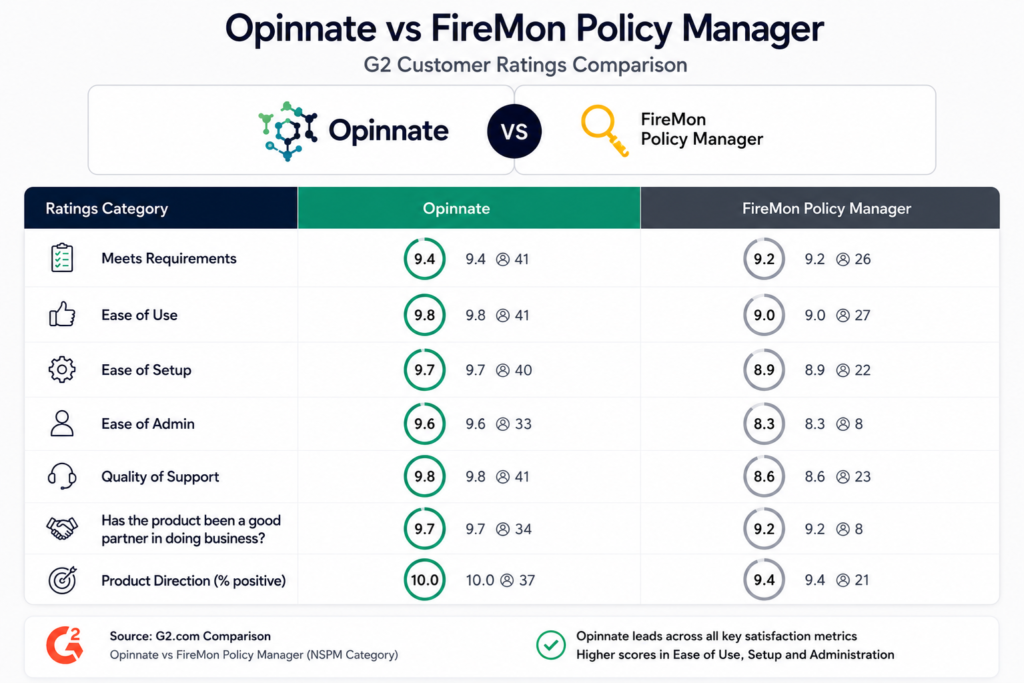
Switching from FireMon? What to Consider Before You Migrate
Determine how current firewall policies and rule information will be handled during the transition and where rebuilding may be required.
Establish how the change can take place without creating enforcement gaps or interrupting important security processes.
Consider whether the existing and new environments can be evaluated in parallel while policies and workflows are validated.
Assess the on boarding required so administrators and security teams can become comfortable with the new workflow.
Review how current approvals, change requests, optimisation activities, and reporting requirements will work in the new environment
Define the steps available if implementation needs to be paused, adjusted, or rolled back
Why Organisations Choose Opinnate Over FireMon
A streamlined approach for teams seeking easier policy operations, intelligent analysis, and governance that stays active throughout the policy lifecycle
Faster Deployment without Unnecessary Complexity
AI Driven Policy Analysis and Intelligent Automation
Governance across the Full Policy Lifecycle
Works With the Security Infrastructure You Already Have
Simpler Administration and Stronger Team Adoption
Organisations considering a move away from FireMon are often looking for a better operational experience rather than simply replacing one feature set with another. The goal is to make policy analysis more useful, reduce repetitive work, and create a clearer route from security insight to approved action.
For
teams that want to make firewall policy operations easier, reduce repetitive
administration, and connect analysis with controlled action, Opinnate offers a
practical alternative to FireMon with a focus on ongoing visibility and
governance.
Frequently Asked Questions
Security teams may evaluate FireMon alternatives when they are looking for a simpler operating model, quicker deployment, less manual coordination, or stronger links between policy analysis and governed change. The right choice will depend on the organisation’s firewall environment, internal processes, security objectives, and governance requirements.
Opinnate can be a strong option for organisations that want policy visibility, analysis, optimisation, automation, and governance connected within a more streamlined workflow. It is designed to help teams reduce repetitive policy work and make ongoing firewall policy operations easier to manage.
In hybrid environments, security teams need policy management that can work across their existing security infrastructure without adding unnecessary administrative burden. Opinnate is designed to support modern and hybrid environments while helping teams maintain visibility, streamline policy operations, and keep governance consistent.
The effort involved depends on the size and complexity of the firewall environment, existing policies, integrations, workflows, and internal requirements. A structured transition that includes planning, validation, testing, and phased implementation can help teams move forward while limiting disruption to day to day security operations.
Opinnate brings policy visibility, analysis, optimisation, automation, and governance together as part of an ongoing workflow. This allows security teams to spend less effort coordinating separate policy tasks and focus more on making controlled improvements while maintaining consistent governance.